
ISO 27001 consulting for practical certification readiness.
Build an information security management system your organisation can operate, address priority gaps and prepare for independent certification with experienced advisory support.
Sydney operating base · On-site across NSW · Remote across Australia
An ISO 27001 gap analysis that leads to decisions.
A gap assessment compares your current information security management system with ISO/IEC 27001 requirements and the controls relevant to your risks and scope. Reviewing Annex A alone misses leadership, risk assessment, competence, internal audit, management review and continual improvement.
Start with the business reason for assurance and the proposed ISMS boundary. Bring policies, asset and supplier records, the risk register, any Statement of Applicability, operating evidence and previous audit findings. Where evidence is missing, the assessment should say so rather than infer implementation from a policy.
The output is a prioritised gap register: the requirement, evidence reviewed, the gap, business risk, owner, dependencies and next action. Management decides the treatment priorities. Implementation support and internal audit are separate activities; an independent certification body conducts the certification audit and decides whether to issue a certificate.
What you get out of it
- A right-sized ISMS you’ll still be running two years after audit
- A defensible Statement of Applicability
- Risk assessment methodology mapped to real business risks
- The Annex A control set implemented at the right depth
- Internal audit and management review cadence that isn’t theatre
- Preparation and support for Stage 1 and Stage 2 certification audits
How we work with you
ISO 27001 gap analysis
Structured review against ISO/IEC 27001:2022 clauses and Annex A. Output: a prioritised gap list with effort, owner and target date.
ISMS design & buildout
The full artefact set an assessor expects — scope, policy suite, risk methodology, SoA, procedures — sized to your organisation.
Risk assessment & treatment
A repeatable risk methodology that maps to real business risks, not a spreadsheet nobody reads. Includes treatment plans with owners.
Annex A control implementation
Use Annex A as a reference when selecting necessary risk treatments. Implement applicable controls and document inclusion, exclusion and implementation status in the Statement of Applicability.
Internal audit programme
A rolling internal audit calendar, competency-appropriate auditors, and management review cadence that actually surfaces issues.
Certification support
Guidance on selecting a certification body, preparing for Stage 1 and Stage 2, and responding to non-conformances. Certification decisions are made independently by the certification body.
Why businesses bring us in
Make AI useful. Make cybersecurity work. Senior technology leadership that connects the advice with the work needed to put it into practice.
Cyber hardening, not just alerts
We prioritise the fixes that matter, harden identity, devices and backups, and line the work up with the ACSC Essential Eight and APRA CPS 234 without disrupting daily operations.
AI adoption with guardrails
We pick useful AI use cases, set a clear usage policy and protect your data under the Privacy Act before staff start pasting sensitive information into public tools.
Team structure and delivery
Advice fails when nobody owns it. We set clear ownership across staff, suppliers and leadership, then stay involved until the work is done.
Talk it through
Ready to scope this engagement?
Share the decision or constraint. A senior operator replies within one business day — no sales pod, no scripted discovery.
- A senior operator reads it
- Reply within one business day
- No pitch, no obligation
Pressure-test the decision in the Platform.
Run two full decision analyses free, compare practical paths and create a Decision Record and Tactical Plan.
Frequently asked
How long does ISO 27001 take end-to-end?+
For a mid-sized SME with no prior ISMS, budget six to nine months from kickoff to Stage 2 audit. Faster is possible with an experienced internal team; slower is common when a business tries to do it in the background of everything else.
Is an ISO 27001 gap analysis the same as an audit?+
No. A gap analysis establishes the starting position and a remediation plan. An internal audit evaluates the ISMS against agreed criteria with appropriate objectivity and impartiality. A certification audit is performed by an independent certification body. A gap report or completed checklist does not award certification.
What determines the scope and cost of a gap assessment?+
The ISMS boundary, sites, systems, suppliers, existing documentation and access to operating evidence drive the effort. We agree these inputs before quoting the work. A narrow scope must still reflect the information and services the organisation needs to protect; it should not hide material dependencies.
ISO/IEC 27001:2022 vs 2013 — what changed?+
Annex A was restructured from 114 controls into 93 across four themes (Organisational, People, Physical, Technological), and 11 controls are net new — including threat intelligence, cloud services, data leakage prevention and secure coding.
Do we need every Annex A control?+
No. The Statement of Applicability is where you justify which controls apply and why. A good SoA is defensible, not maximalist.
Can this run alongside ISO 42001?+
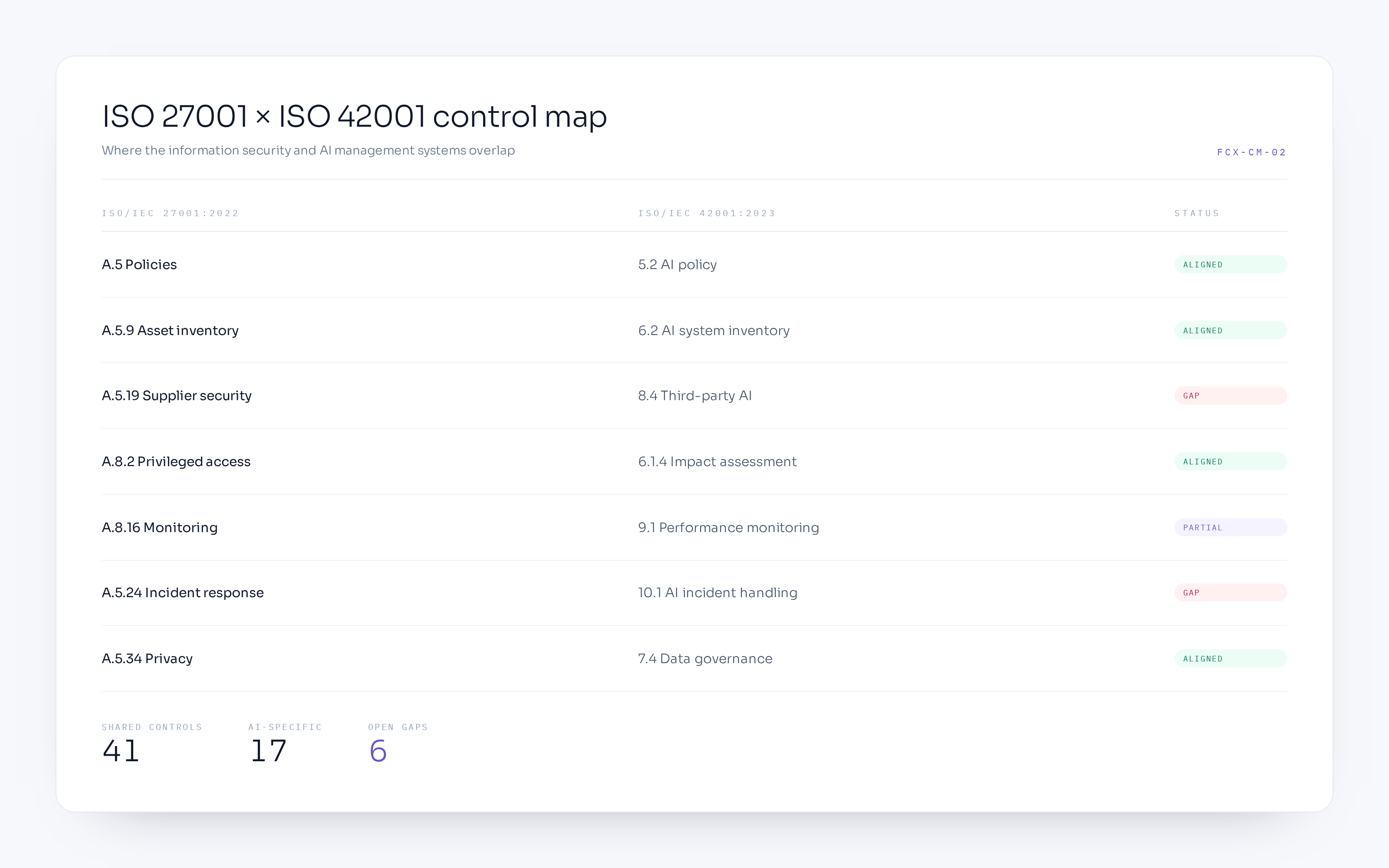
Yes. A coordinated programme can reuse relevant evidence and align shared processes, where appropriate. The effort and any savings depend on your existing systems, scope and audit arrangements.
Which certification bodies do you work with?+
JAS-ANZ accredited CBs across Australia. We’ll match you to a CB whose auditors know your sector and whose commercial position fits your budget and timeline.
What if we’re only doing this because a client asked?+
Very common. We’ll shape the scope to the specific client requirement and design the ISMS so it can grow if commercial pressure demands wider coverage later — without a rebuild.
Start a useful conversation
Talk to a senior advisor
Tell us the decision, constraint or opportunity. A senior operator responds within one business day.
A senior operator reads it
Not a sales team. The person who replies is the person who would do the work.
Reply within one business day
With a useful next step, or a straight answer if that is all you need.
No pitch, no obligation
Ask one question. You decide whether there is a second conversation.