ISO 42001 consultants — AI Management Systems for Australian organisations.
Part of the compliance capability inside our Fractional CIO practice. We design and stand up an AI Management System (AIMS) that satisfies ISO 42001, maps to Privacy Act obligations and the Australian Voluntary AI Safety Standard, and reflects how you actually adopt AI.
Sydney operating base · On-site across NSW · Remote across Australia
What you get out of it
- A designed AIMS that satisfies ISO 42001 clauses
- An AI policy suite your legal team, board and clients will sign
- An AI risk register that tracks real risks, not model trivia
- Impact assessment methodology for new AI use cases
- Human oversight controls that actually work in day-to-day use
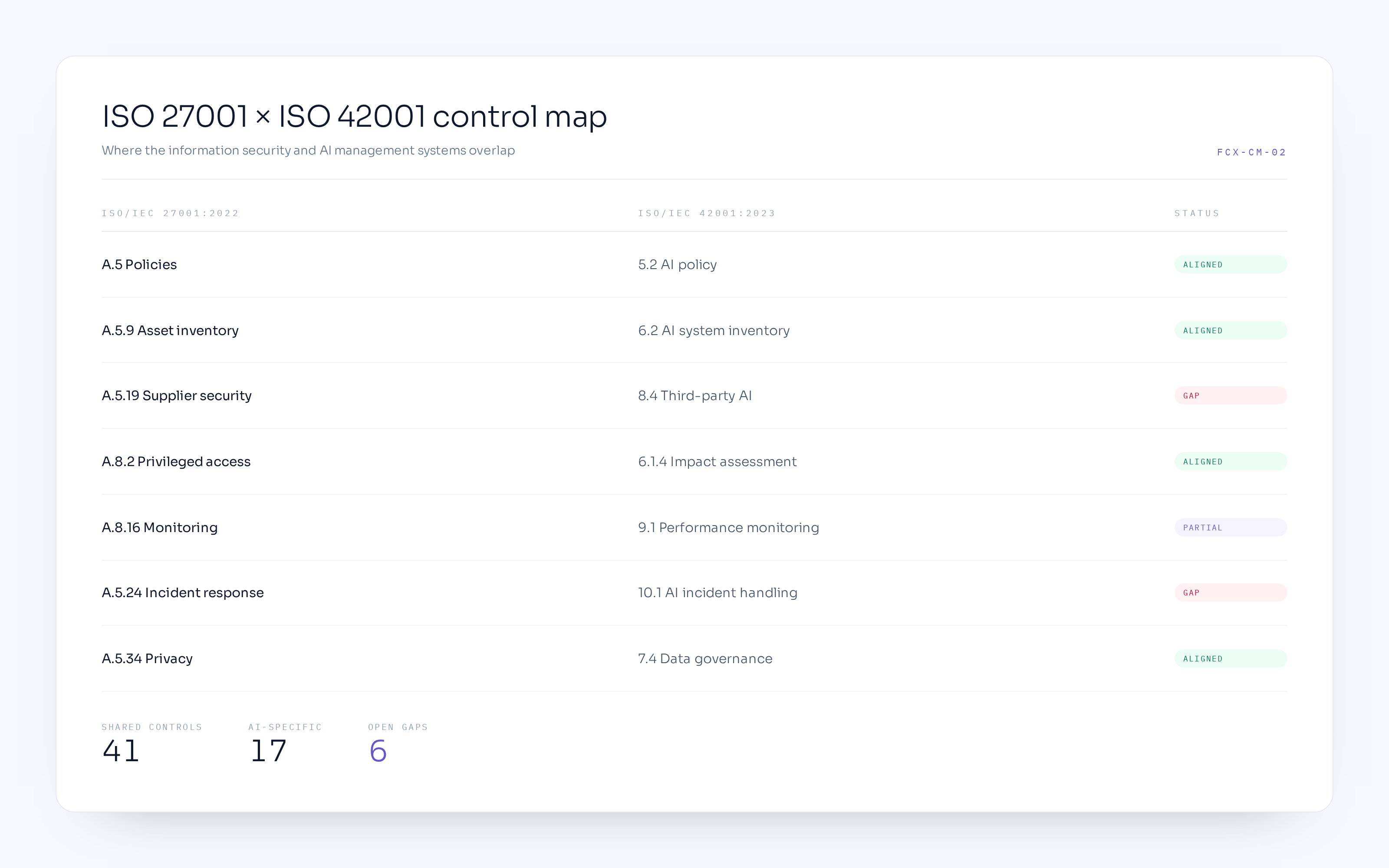
- A joint 27001 + 42001 audit programme, not two
How we work with you
AIMS design workshop
A two-day executive workshop to define your AI ambition, principles, risk appetite and the shape of your AIMS.
AI policy pack
AI acceptable use, AI risk management, model lifecycle, data & training, human oversight — the full policy set aligned to ISO 42001 controls.
AI obligations register
Every applicable obligation in one place — ISO 42001, ISO 27001, the Privacy Act, sector regulation, contractual clauses and customer security schedules — with an owner against each.
AI risk register
A working AI risk register categorised across security, privacy, IP, bias, robustness, transparency, human oversight and third-party risk.
AI impact assessment
A structured AIIA methodology so every new AI use case is assessed before it goes to production — with an owner and a sign-off.
Evidence and board reporting pack
Policies, approval records, testing evidence and monitoring outputs assembled the way certification auditors read them, plus a quarterly one-page compliance view for the board.
ISO 27001 + 42001 joint programme
A combined programme that shares evidence, controls and audit cycles across both standards, cutting total effort by roughly a third.
Why FORTE/CYBERx Advisory
Not another consulting firm. Former enterprise CIOs bringing operator-grade cyber and AI leadership to Australian SMEs.
One accountable CIO, not a panel
Cyber strategy, compliance and AI sit with one operator who has led technology inside banking, healthcare, higher education and government.
AI-ready, not AI-hyped
ISO 42001 practitioners. We secure the enterprise for AI before spinning up flashy tools. Frameworks first, tooling second.
Three capabilities, one programme
Cybersecurity strategy, ISO 27001 and ISO 42001 compliance, and AI consulting delivered as one plan with shared evidence and a single audit cycle.
Local, but not small
Sydney-based, delivering across NSW. On-site when it matters, remote-first when it does not.
Platform-augmented delivery
Every engagement includes FORTE/CYBERx platform access. Our consultants use it live in your board meetings — you keep using it after we leave.
Ready to scope this engagement?
Share the decision or constraint. A senior operator replies within one business day — no sales pod, no scripted discovery.
Pressure-test the decision in the Platform.
Run two full decision analyses free, compare practical paths and create a Decision Record and Tactical Plan.
Implementation guides
Scope and leadership: clauses 4 and 5
Define AIMS boundaries, interested parties, the AI policy and executive accountability.
Read the guideAI risk and impact assessment
Run clause 6 risk assessment alongside an ISO 42005 AI system impact assessment.
Read the guideStatement of Applicability and Annex A
Work through the Annex A control set and justify every inclusion and exclusion.
Read the guideAI system lifecycle controls
Requirements, design records, verification, deployment gates, monitoring and retirement.
Read the guideData governance and provenance
Provenance, quality and preparation records reconciled with Privacy Act obligations.
Read the guideInternal audit and certification readiness
Clause 9 and 10 audit and review, nonconformities, and Stage 1 / Stage 2 preparation.
Read the guideFrequently asked
Is AI compliance mandatory in Australia?+
There is no single AI act in force. Obligations arrive through the Privacy Act, sector regulation, directors’ duties, contracts and customer assurance requirements, with the Voluntary AI Safety Standard setting the expected guardrails. Most organisations are already in scope through one of these paths.
What is ISO 42001?+
ISO/IEC 42001:2023 is the first international standard for AI Management Systems, published in December 2023. It sets out how an organisation should govern its use and development of AI — through policy, risk management, impact assessment, human oversight and continual improvement.
Do we need ISO 42001 certification, or is the framework enough?+
For most SMEs, adopting the framework gives you 80 percent of the value. Formal certification matters if you’re in a regulated sector, sell into large enterprises, or want the third-party assurance signal.
How does ISO 42001 relate to the EU AI Act and Australia’s AI guardrails?+
ISO 42001 is a governance framework that helps you satisfy either. The EU AI Act is prescriptive law targeted at specific AI systems. Australia’s voluntary AI Safety Standard (2024) aligns closely with ISO 42001 principles. Building against 42001 sets you up for both.
Who owns the AIMS in an SME?+
Usually a small AI governance committee — the CIO/CISO or fractional equivalent, the head of data, a legal or risk representative, and an executive sponsor. We help you stand it up and coach the members through the first review cycles.
Can we run 27001 and 42001 together?+
Yes — this is our recommended path. Overlap in leadership, risk, awareness, supplier and audit clauses means a joint programme cuts your total effort by 25–40 percent compared to sequential.
What tooling do we need?+
You don’t need dedicated AI governance tooling to get started. A well-designed GRC surface (or the FORTE/CYBERx platform) covers the artefacts and cadence you need through certification.
Talk to a senior advisor
Tell us the decision, constraint or opportunity. A senior operator responds within one business day.